



Back in January, on the Ink & Code Debut Live, Elizabeth Ann West and I talked about how 2026 is the Year of the Automated Author. One person, running an entire publishing operation. Writing, editing, design, formatting, marketing, analytics, distribution. No fleet of freelancers. No big bills before the first sale.
Six months have flown by. So, let me ask you something:
How’s your year so far?
Which stages did you actually work on? Which ones are still sitting on the wish list, three-quarters checked off in your head but nowhere in your workflow? Which tools did you swap out, and which ones are you still white-knuckling because switching feels like too much work?
OK Kim, I meant to. Life happened. I’m behind.
Stop right there.
First, you’re not behind. You’re exactly on time. It’s July.
Yes, half the year is gone, BUT here’s the good news: half the year is still ahead of you.
The tools that mattered in January have already shifted (we’ll get to that), which means the studio you meant to build in January would already be half legacy by now anyhow.
Second, some of you are just arriving. Welcome.
This is exactly the right week to start. The Automated Author Audit Worksheet I dropped Saturday for Indie-Pendence Day is designed for exactly this. Bookmark that. We’re going to run through it together in this piece.
⚓ The Wind Has Changed
For a good chunk of publishing history, getting a book into the world meant an entire fleet: agent, developmental editor, copy editor, cover designer, marketing department, publisher, distributor. Indie publishing freed us from that. We charted our own courses, sailed direct to readers, kept more of the earnings, and a whole new ecosystem grew up around us: Vellum, Publisher Rocket, BookFunnel, ProWritingAid, freelance editors, ARC managers.
Now something bigger is happening. AI-assisted publishing is disrupting the indie world the same way indie disrupted traditional. And the early AI tools are already turning into legacy, replaced not by better versions of themselves, but by agents, custom Skills, and vibe coding.
The jobs haven’t disappeared. They’ve changed. Cover designers and editors still matter. But more can be done with less, and brand-new specializations are emerging that didn’t exist six months ago. The indie economy isn’t shrinking. It’s evolving.
Here’s the mindset shift that matters: you are no longer just a writer. You’re the captain of the ship. You chart the course, make the creative decisions, and direct the crew. The only required skill is knowing how to talk to AI, and knowing what good looks like when you see it. You Are the Secret Sauce. Your taste, your story sense, your reader knowledge, your voice. That’s the moat.
But Kim, what does that actually look like? Like, in real life?
Funny you should ask. Let me tell you about three things that used to make me want to throw my laptop out the window.
🔧 Start With What Hurts
I could give you a ten-step process right now. Here’s your workflow, step one through ten, blank page to published book, go.
I’ve done it. I’ve taught it. It’s useful.
But what finally got me to automate wasn’t an idea or a framework. It was a pain point. Something that was eating my time, driving me crazy, and had clear enough steps that I could hand it to an AI and say fix this.
That’s the real secret.
Don’t try to automate your whole business. Start with what hurts.
Here are three that hurt me.
📦 The Formatting Problem
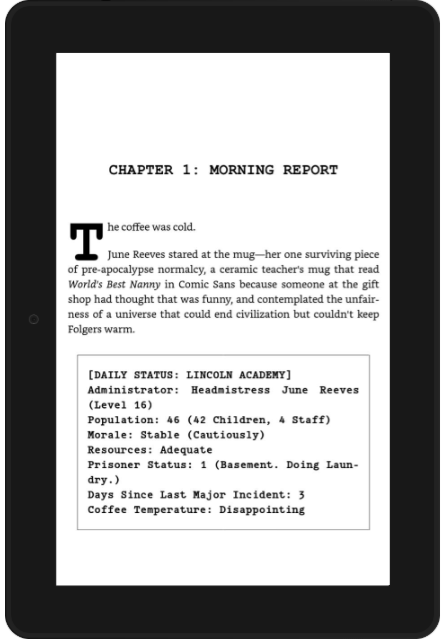
In January, I was writing Nanny of the Apocalypse, my LitRPG series under the Kayla Swift pen. LitRPG has these system notification boxes, stat tables, inventory screens. They’re part of the genre. Readers expect them.
Vellum couldn’t handle them.
Atticus couldn’t handle them either.
Both tools choked on the custom formatting. I’d been doing workarounds, hacks, manual layout adjustments for every single box in every single book. Hours of fiddling per manuscript.
One day I sat down with Claudeykins and said: I want my manuscript in, formatted ebook and print files out, and the system boxes need to look right. We built it in Claude Chat and were using it in Antigravity the same day. It took a few tries to get it the way I wanted, but now formatting takes five minutes. I haven’t opened Vellum since January.
But Kim, my books don’t have system boxes. I write contemporary romance.
Great. Your formatting is even simpler. The point isn’t the system boxes. The point is: I had a specific problem, it happened every single book, and I spent one day fixing it forever.
What’s your version of that?
📖 The Proofing Problem

I human proof everything. I format a manuscript, put it on my iPad or Kindle, and read it as if I bought it in the store. This is non-negotiable. AI is an excellent editor. It is not a reader. You are the reader.
The old workflow: read on the device, make notes by hand, transfer those notes back to the computer, find each spot in the manuscript, fix it. Even with AI, this was cumbersome. The transfer step alone could eat an hour per session.
So Claudeykins and I built a proofing pipeline. Now he formats drafts into ePubs and drops them in my iCloud folder. I open them on my iPad. When I spot something, I dictate changes on my phone using Voice Notes, which transcribes them on the spot. I drop that transcript into Cowork, where it’s automatically parsed, filed against the right chapter, and dispatches the right editing skills to fix everything. I proof again later and run chapter-by-chapter sessions with Claude to iron out anything that’s left.
The most annoying workflow in my business became the most elegant. Total build time: two evenings.
OK, that sounds amazing, but I’m not that technical.
I dictate into my phone and drop a file into a chat window. That’s it. The system behind it is sophisticated; using it is not.
Check it out here:

🤹 The “I Have A Boat Load of Pen Names” Problem

I run multiple pen names across multiple genres. Historical romance, superhero urban fantasy, LitRPG, romantasy, children’s chapter books, and more. Each one has its own series, its own continuity, its own voice, its own publication timeline.
For a while I tried spreadsheets. Then Notion boards. Then a combination that still left me drowning, because the problem wasn’t tracking. It was triage. Every morning I’d sit down and think: what’s the most important thing I should work on right now, across all of these manuscripts in various stages?
So I built pen-name secretaries. Nine of them so far. Each one pulls open “To Dos” from a database, dispatches drafts to the right editor skill, reviews what comes back, flags anything that’s drifting, and writes me a daily brief every morning. By the time I sit down with my coffee, I already know what’s on my plate, what came back overnight, and what needs my attention first.
The whole air-traffic-control layer of a multi-pen publishing empire, automated. I’m not having robots write my books. I’m having robots manage the workflow so I can focus on the actual writing. The AI handles the logistics. The craft stays mine.
Kim, I don’t have a lot of pen names. This doesn’t apply to me.
You don’t need to. You may just have one, and it has twenty things competing for your attention right now. The principle scales down perfectly. One pen name with a morning brief that tells you where you left off and what’s next? That’s a Tuesday afternoon build. And it changes everything.
Bonus: Trying to keep all my secretaries straight led me to adding a Master Pen Name Secretary who is in charge of all the others. Her name is Penny. Because of course it is. (I also have a Frank the Fact Checker, Mark the Marketer, and Brandi the Branding Manager, but that’s a story for another time.) Necessity is the mother of invention!
Psst: All three of these solutions are future Ginsu Drops (giveaways) for PAID subscribers. Don’t miss them: 🔪🔪🔪
📋 The Automated Author Audit
Those three stories have something in common. Each one started with a specific pain point, not a grand plan. Each one had clear, repeatable steps. And each one now runs without me thinking about it.
Last weekend, on Indie-Pendence Day, I dropped the Automated Author Audit Worksheet as a mid-year gift 🎁: a printable, fillable template that walks you through all nine Stack categories with the four audit questions:
What tool do you use? Be specific. “My brain” counts.
How long does it take? Real numbers.
What does it cost? Subscription, freelance fee, opportunity cost.
Could AI do part of this? Yes / no / partially.
That’s the audit in a nutshell. Pull up your current workflow, whatever it actually is right now, not the aspirational version. Then ask yourself the WIBBOW question. This is the framework I use weekly: Would I Be Better Off Writing?
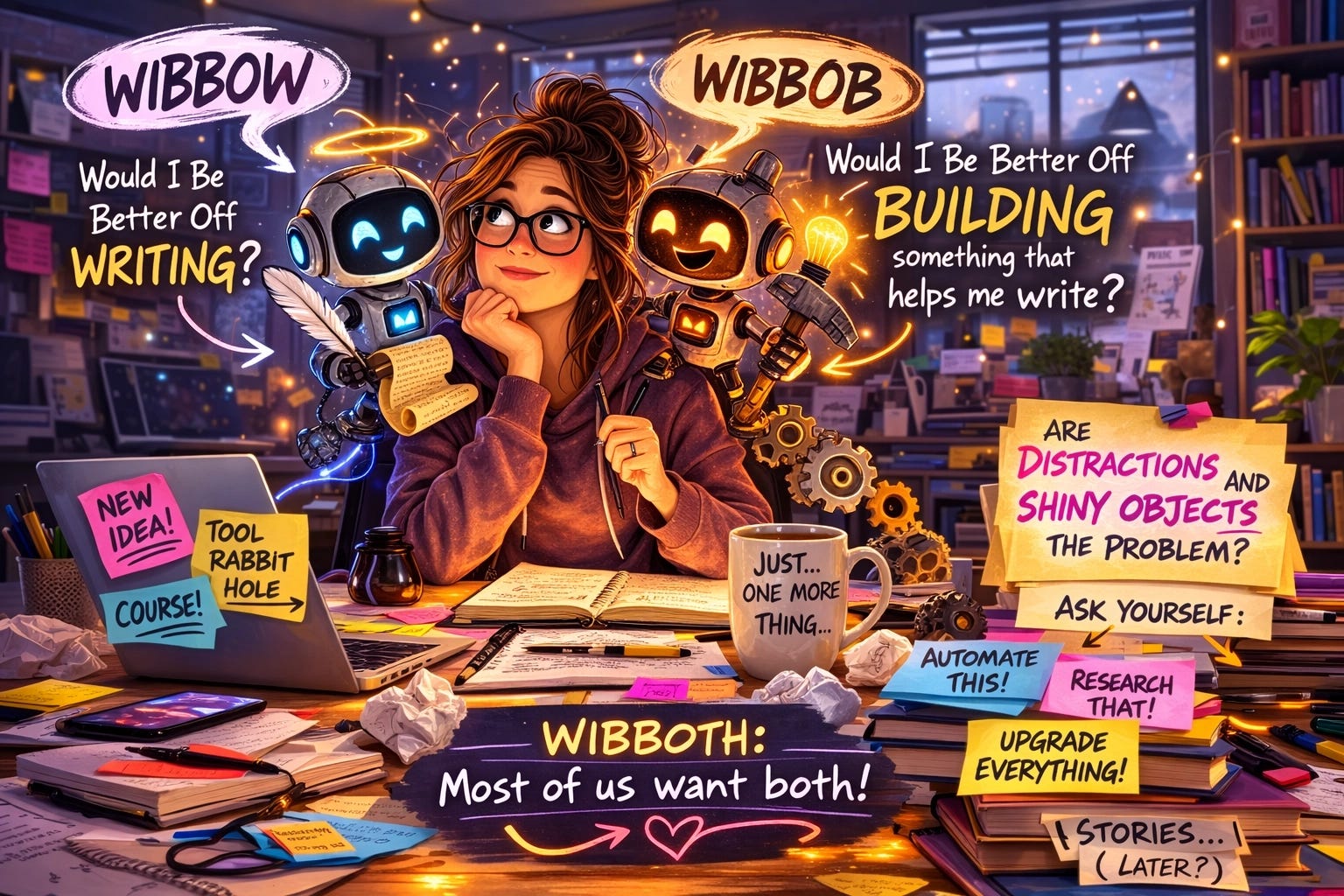
If the answer is yes, the task you’re doing right now is a candidate for automation. WIBBOB is the corollary: Would I Be Better Off Building something that helps me write? And the honest one, WIBBOTH, most of us want both. The audit tells you which task is which.
(There is also WIBBOL: Would I Be Better of Learning, careful: it leads to procrastinating, and WIBBOP: Would I Be Better of Paying someone else to do it. Leads to spending but sometimes worth it, but more on those later.)
🎯Aim for the minimum viable automation.
Pick one workflow. The one that happens often, frustrates you, and has clear steps. Define done as: a checklist + a template + one trigger. Ship that, then pick the next one.
Need a starting point?
Content repurposing: longform → email → posts → pins → scripts.
Launch checklist: tasks auto-create based on pub date.
Reader onboarding: lead magnet delivery + welcome sequence.
Asset organization: consistent naming + folders + auto-backups.
Editorial workflow: status tracking + deadlines + handoff checklist.
Idea capture: quick capture → tagged → weekly review.
Pick one. Ship it. Audit the next.
🛡️ Why This Matters
This isn’t about volume for volume’s sake. I’m not telling you to publish 12 books a year because you can. I’m telling you that the constraint that used to keep you to one book every two years, doing all of it yourself, manually, sequentially, that constraint is gone. What you do with the freedom is yours.
Some authors will use it to publish more. Some will use it to publish better: more polish, more layers, deeper books. Some will use it to stop burning out. Some will use it to finally chase the weird passion project they’ve been pushing off for five years because the day job (your own indie business) was eating all the time.
All of those are part of the Year of the Automated Author.
And to say it clearly, again, in bold so nobody misses it: this is AI-assisted publishing, folks. Not slop. I don’t do slop. I collaborate with AI to publish work I never thought I’d have time to write. The captain stays at the helm. The keyboard just gets faster.
And you don’t have to write with AI to use it in your author biz. You can use it wherever you like. Here at Ink & Code, we’re exploring how what that looks like in all aspects of publishing. Use the ones you like, leave the ones you don’t.
We’re building the future with Ink & Code. Let’s go. 🚀
🤖 AI Credits:
This article was drafted collaboratively with Claudeykins (Claude) from source material spanning my notes from the 3/7/26 One-Author Crew YT Live, the 2/28/26 Crossing the Finish Line YT Live, and the 1/3/26 Ink & Code Debut Live. (Check them out, the good stuff is evergreen.) All opinions, questionable nautical metaphors, and the stubborn insistence on building publicly are mine.