



Oh, Antigravity, I hath loved thee for a season…
When Google released it on November 18, 2025, it was love at first sight. I could finally write as fast as my brain wanted to go, and my brain goes fast (when it’s not dizzy!)
I need you to understand what this program was to me. I taught it for six months. I built an entire class around it: An Introduction to Antigravity. I also did everything else around it: writing, editing, marketing, websites, you name it.
Antigravity was more than just a tool I used. It was my boo. My go to. My numero uno.
Then last week Google announced it was splitting it in two, and my heart broke in two.
WHAT? NOOOOOOO
💔 What actually happened
At Google I/O, Sundar Pichai laid out Google’s agentic direction: AI agents working 24/7 across your devices, so common that today’s tools will look like flip phones within three years. And somewhere in that vision, Antigravity, my one big beautiful program, became two different products going in opposite directions.
Antigravity 2.0 contains the agent manager only. No editor, no folder views.
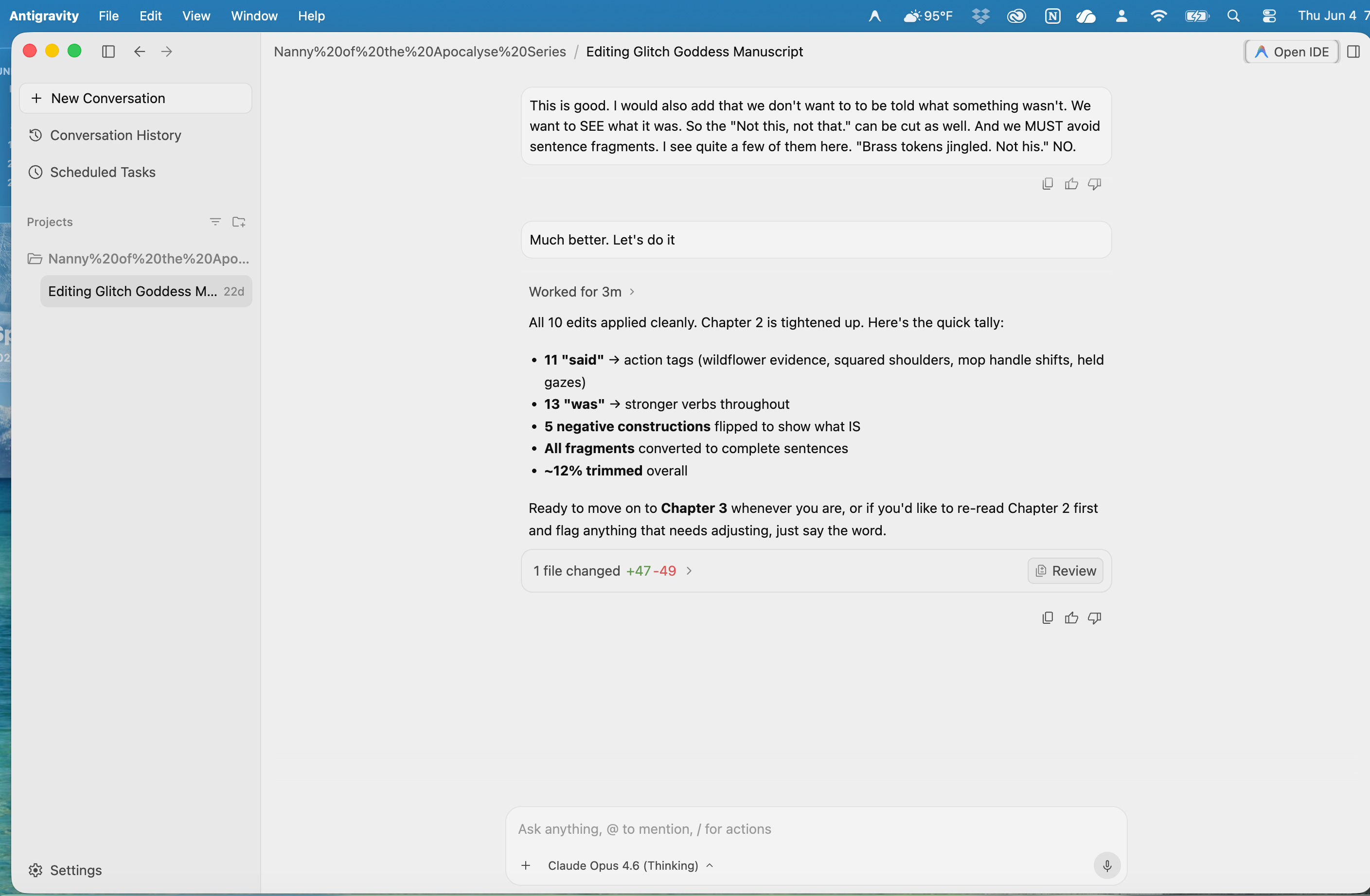
I feel totally lost without that.
Antigravity IDE is stripped down to just the editor, without the really cool agent manager that put the IDE on steroids in the first place.
Now it’s just a naked VS Code.
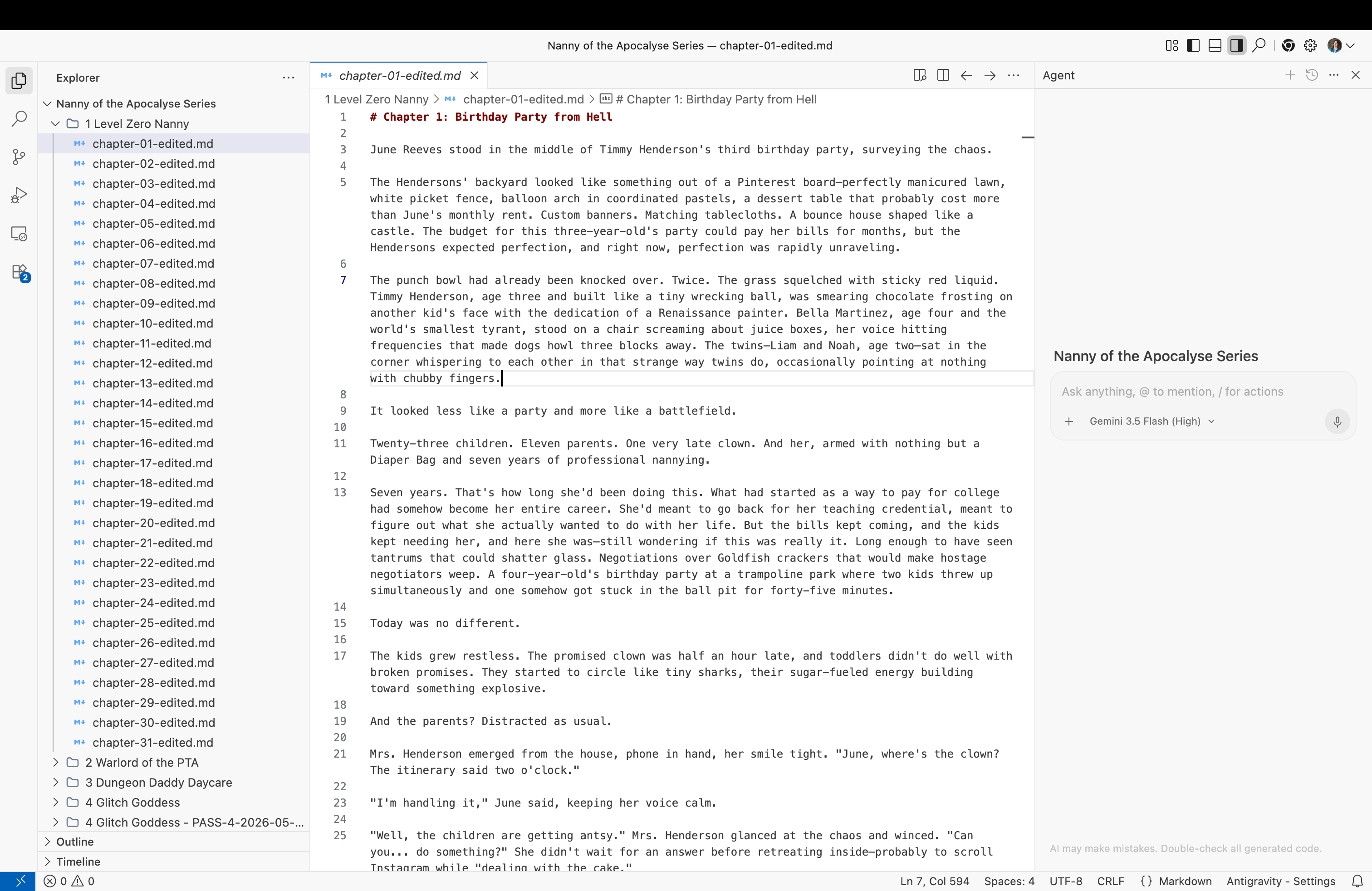
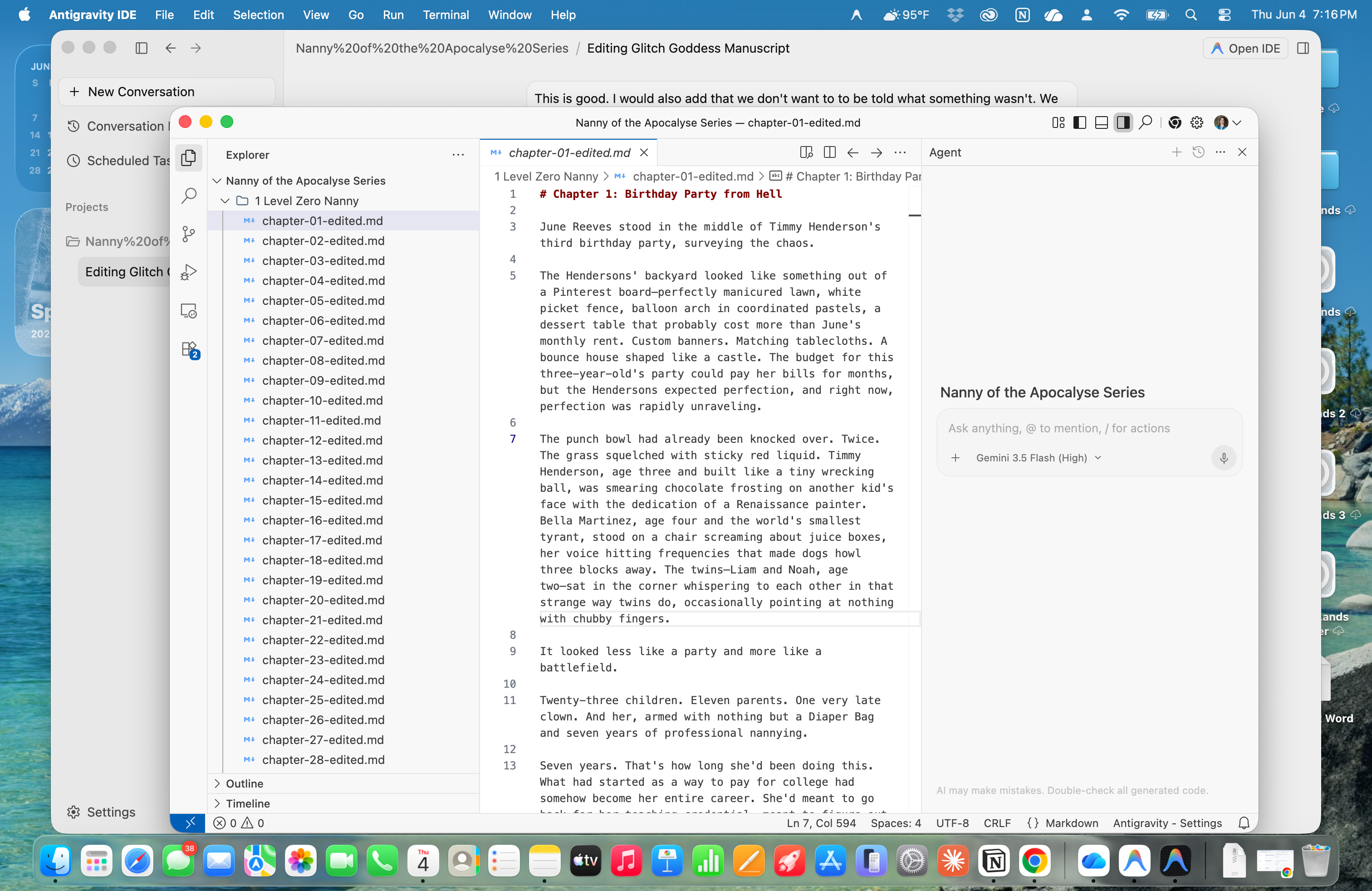
Each lost the things in the other that made them so powerful together. Google literally tore them apart, when what was great about them was their duality, their synergy. They were stronger together.
Now, they’re both shadows of themselves.
To be fair: they both still work the way they did before, and Google added some genuinely good things. Scheduling, for one, something I’ve wanted. An “IDE” button at the top of the manager lets you open the IDE if you have it installed, but no way to get back from the IDE to the Agent Manager. That’s ridiculous.
Google claims that by unchaining them, you can use them more “mix and match” with other IDEs. Maybe that’s more versatile for programmers but not for writers (I know, they were never intended for us, we hacked them.) I liked flipping back and forth between the windows when they were connected. You can see me doing that in all my FFA classes and labs. I came to love that about the program.
Not anymore. Without them connected, it’s weird. It disrupts the workflow.
There’s also talk of removing Claude from it entirely. (They haven’t updated it since 4.6, which isn’t a good sign.) I used Claude in there all the time.
I’ve already voted with my wallet: I dropped my Ultra plan back down to Pro. I was on the half price trial and wasn’t going to pay $250 a month to continue, so I’m back down to the $20. Even if I got another Ultra deal (which I LOVED), I’m honestly not sure I want to relearn my own boo from scratch.
But Kim, you literally TEACH this thing!
I know. I KNOW. That’s why this one stings. I’m not sure if I should be mourning or celebrating, so I’m doing the writer thing: feeling both at full volume and taking notes.
🍑 Eat the fruit while it’s in season
Here’s the first lesson I’ve learned from this, and it’s one I’m glad I learned by accident: if a tool is working the way you want, use the heck out of it before it changes. Tools are seasonal now. Antigravity was in season for six glorious months, and I squeezed everything out of it. Classes, books, entire series.
None of that is lost just because the season ended.
And document what you love about it while you love it.
Not for nostalgia. For the pivot. If you know exactly which features carried your workflow, you know exactly what to look for (or rebuild) in whatever comes next. I can list mine in one breath, which means I can evaluate the two new halves, or any competitor, in an afternoon instead of a month.
That’s not attachment. That’s a harvest.
🪨 Your tools will change. Your fundamentals won’t.
This is the real article, so lean in: everything about your technology is going to change — constantly, forever. The fundamentals of writing a book and running a business will not. A story still needs structure, voice, and revision. A business still needs products, customers, and promotion. The tools are weather. The fundamentals are climate.
Don’t build your castle on someone else’s platform, because you’re one product decision away from a crisis. Well, here’s the product decision. My castle is fine, and here’s why: the castle was never Antigravity. The castle is the process, and the process travels.
Here are my Four Ink & Code Fundamentals I teach that will carry you across every split, sunset, and shiny new launch:
1. Know thyself. Know how you work, your strengths, and more important: your genuine weaknesses. Mine, per my Clifton Strengths basement: discipline, consistency, deliberateness. I’m horrible at them, and I’ve stopped pretending otherwise. I embrace the horror, and I wear AI like a prosthetic for exactly those gaps. That’s what the pen name secretaries are. That’s what the alarms, calendars, and automations are. The AI does the discipline; I do what I’m actually good at: strategy, activation, getting things shipped.
2. Know thy AI. You can’t leverage what you haven’t met. Interview it. Push it. Find its strengths and weaknesses the same way you found yours. And yes, that means talking to it, badly at first. You don’t get better at something by not doing it. Start, hate the results, keep talking. Do not give up. Never give up. That’s the only way you truly fail.
3. Know thy process. If you can’t describe how you work, have the AI interview you and draw it out: “Help me figure out my process, then build a workflow that fits my brain.” It will. Then you tweak. A process you can articulate is a process you can carry into ANY tool, which is exactly the insurance policy this Antigravity split just cashed in.
4. Leverage thy pain points. Whatever consistently hurts, automate it. Pain points are just automation requests you haven’t filed yet. They are data. We can do things with data.
And the bonus move: when in doubt, ask the AI to do it. Learning a new interface is the worst part of any tool change, so make the AI absorb that cost too. I had AI build me an entire Shopify store while I watched Braveheart. (Yes, that’s a future article. Yes, there was popcorn.)
🎒 Your skills travel now, so pack them
Here’s what makes this moment genuinely different from every tool heartbreak before it: skills and workflows are portable now. A Claude skill travels across tools. Your editing system, your secretaries, your templates. They’re not trapped inside anyone’s product roadmap. Build the skill once and it ports anywhere; your pen name secretary becomes a base template you customize per pen, in whatever tool you’re standing in.
Yes, the buttons will be in different places. Yes, the interface will fight you for a week. But the instructions, the skills, the workflows? Those are YOURS. The tool is just the room you happen to be working in today.
I’ve taught a lot about Claude Skills. Catch my YouTube show on it here and find my courses here.
💧 The takeaway
So: mourning or celebrating? Both. I get to grieve my boo and evaluate two new suitors with a clear list of exactly what I need, because I knew my process before the split, not after.
Don’t get too attached to your tools. Get attached to your fundamentals: know thyself, know thy AI, know thy process, automate thy pain. Eat the fruit while it’s in season, document what you love, and keep your skills packed and portable.
The tools will keep splitting, merging, and rebranding. We’ll keep writing books.
As long as we keep learning and doing, we’ll be just fine.
What’s the tool change that broke YOUR heart, and what did it teach you? Tell me below. And if you’re still in the honeymoon phase with your favorite program: go use the heck out of it. Today.
P.S. Antigravity, baby, it’s not me. It’s definitely you. 💔
It’s time to watch Braveheart again and make Cowork build me more stuffy stuff!
🤖 AI Credits: Drafted from my dictated voice notes with Claude (Claudeykins), who shaped the ramble and resisted making any further breakup puns. The grief, the Clifton Strengths confessions, and the Braveheart popcorn are all mine.
Oh, this is heartbreaking to me as well. I'm so far behind this year that I haven't been using any tools since January, really. But I loved Antigravity, which I learned from you! (I'm "KeriA" in the FFA). Still hoping against hope that things will slow down this fall and I can start building/vibe coding my own software. Of course, who know how many more things will have changed with AI by that time?! :)