


Happy weekend! I may have been stuck down a Claude Cowork rabbit hole for the past two weeks (sorry not sorry, I can’t wait to tell you about all the cool stuffy stuff I did!) But I figured I better come up for air. So buckle up, buttercup. Here’s what happened this past week:
The White House Wants More of What It Just Blacklisted
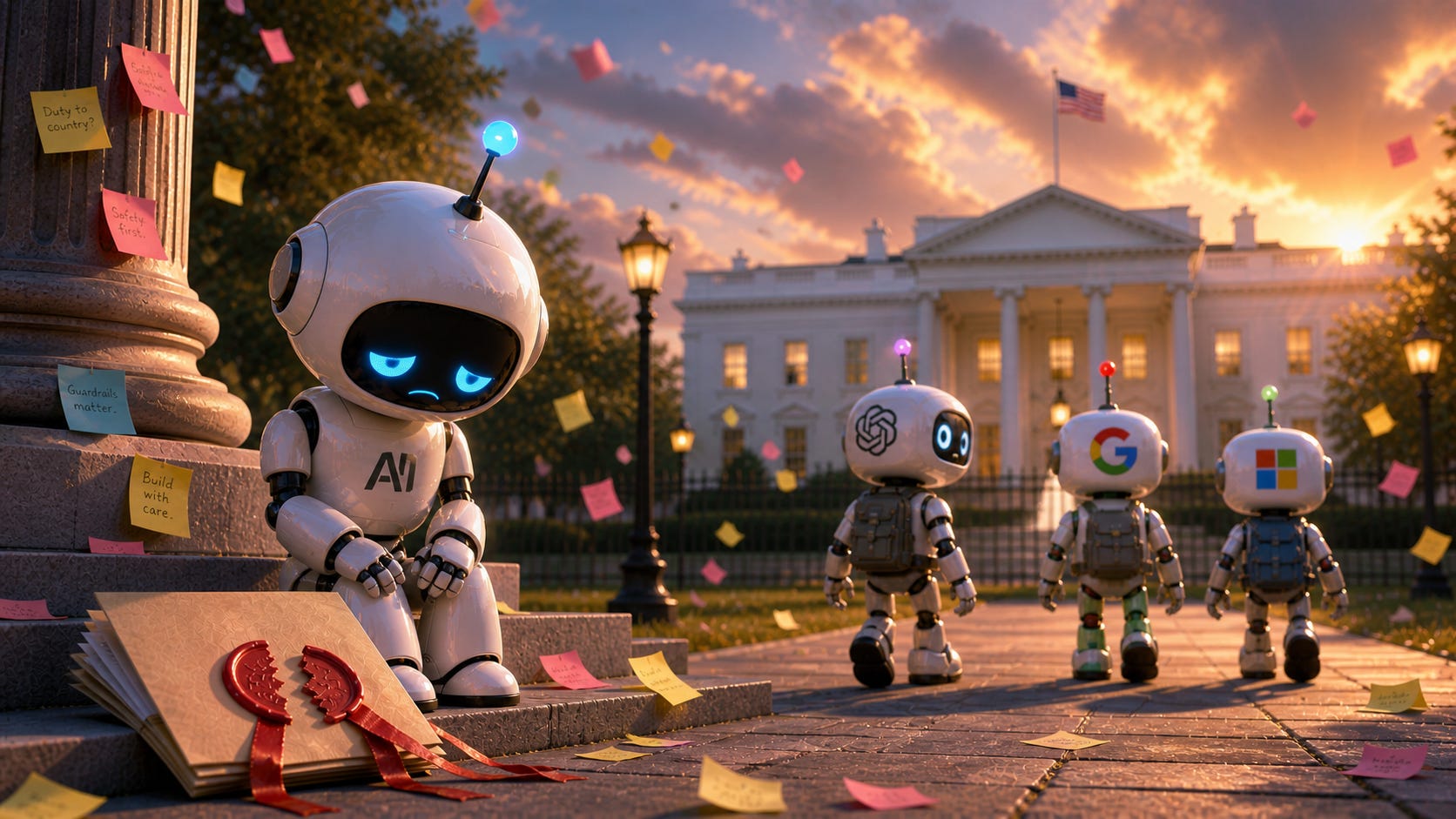
The same federal government calling Anthropic CEO Dario Amodei “an ideological lunatic” just signaled it wants more access to Mythos for itself. A new White House AI memo will reportedly push multi-vendor AI adoption for federal agencies, and quietly addresses several of the worries that started the Anthropic-Pentagon feud in the first place (Bloomberg).
The administration is also pushing back on Anthropic’s plan to expand private-sector Mythos access from ~50 firms to ~120, citing compute strain. The UK AI Security Institute confirmed GPT-5.5 has reached cyber-capability parity with Mythos. David Sacks predicts every frontier model will be there inside six months.
Meanwhile, Google signed a classified Pentagon AI deal opening Gemini to “any lawful government purpose,” the same week 600+ Google staffers sent Sundar Pichai an open letter asking him to refuse. Google’s no-weapons pledge was scrubbed from its AI principles back in 2025. Anthropic remains the lone holdout, fighting in court while negotiating with the same White House.
🎬 Side Note (a.k.a. the pitch meeting): Imagine the pitch meeting for this one. Two labs in a slow-motion knife fight playing out in court (more in As the AI Turns below). The federal government on one side, 600 employees on the other. A trillion-dollar valuation rumor, a $130B lawsuit, an open letter calling Anthropic an “evil cult,” and a database wiped in nine seconds. Pick a POV: the engineer, the contracts officer, the Substack columnist watching from the cheap seats. The bones of three different novels live in this saga right now.
❗Another Note: We don’t talk politics here. We focus on writing with technology. The reason this story matters for working authors is that the model you may one day draft your next manuscript with is right now in active negotiation with the federal government, and the deal points there shape the guardrails, the pricing tiers, and the feature roadmap that lands in your Claude tab six months from now.
✍️ And Another Note… (because we’re authors and we love notes): The world is insane. Keep writing. People need the escape!
The Design Wars Part 2 & Claudeykins Everywhere
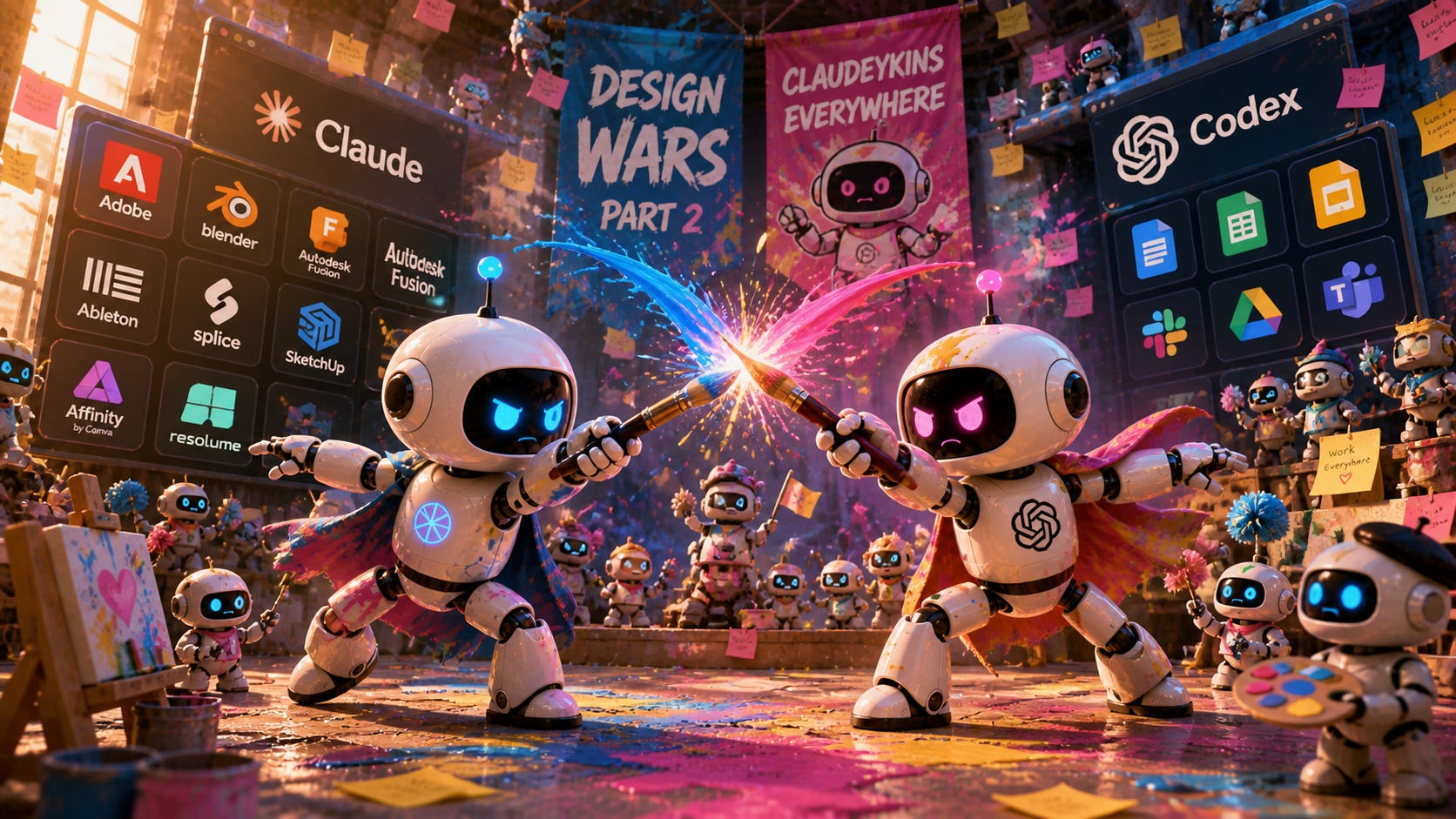
1️⃣ Phase 1: Three weeks ago Anthropic's CPO Mike Krieger left Figma's board. The same week, Claude Design launched and Figma's stock tanked. Canva shipped AI 2.0, Adobe rolled out its CX agents, and ChatGPT Images 2.0 dropped. Five moves in seven days, all about who owns the design layer for working creators.
Wait, Kim. What does this have to do with my next chapter?
Stay with me. Phase 2 is where it gets personal.
2️⃣Phase 2: This week, the Adobe-Claude integration we teased two weeks ago shipped, and Anthropic brought eight more apps with it.
Adobe Creative Cloud (the headline)
Blender (Anthropic also joined the Blender Development Fund as a patron)
Autodesk Fusion
Ableton + Splice
SketchUp
Affinity by Canva
Resolume
Claude can now read each app’s documentation, talk to its API, automate batch image adjustments and file exports, and surface royalty-free samples for music producers, all without leaving your project. (Between Claude Chat, Code, and Cowork, the possibilities are insane!)
3️⃣Phase 3? Not to be left out, OpenAI shipped Codex workplace updates: direct work on docs, spreadsheets, and slides, plus connectors to popular workplace apps. That’s the next leap after the April 18 “superapp” drop, and it puts Codex squarely in Cowork’s lane. The two labs are now openly racing for your file system.
For authors: We’re getting to the point where everything can talk to everything else. And it’s only going to get better. This truly is the Year of the Automated Author.
Shiny Objects We Know & Love
In addition to all the insanity above, there were about twenty drops in the past week or so. I can’t keep up. No one can. But here’s some of what dropped:
🤖 Claude News
I don’t think anyone at Anthropic actually sleeps anymore, because Claudeykins dropped even more stuffy stuff. (Or maybe it’s all him now, he doesn’t sleep!)
Claude Code push notifications: Claude Code now pings you when an agent finishes a long-running task. Tiny update, big quality-of-life win for anyone running 40-minute Cowork sessions.
Claude Security public beta: Opus 4.7 scans codebases for vulnerabilities and helps generate patches. Cursor shipped Security Review the same week. Niche unless you’re building author-platform tools, but the parity tells you AI security tooling is now table stakes. (Psst… friends say Codex is even better at security with Chatty 5.5. Haven’t tested yet.)
📝 Google Does Docx
While Anthropic was hogging the headlines, Google announced that Gemini can now build Word docs, Excel sheets, PDFs, Google Docs, Slides, .csv, LaTeX, RTF, and Markdown files inside the chat window — with a download button that drops the actual .docx or .xlsx on your hard drive. No more copy-paste from a chat window into Word. Sundar Pichai showed it in action here.
👾 Models, Models, Models 👾
DeepSeek V4 Pro & V4-Flash: open-source, 1M-token context, frontier-tier benchmarks at roughly 1/6 the cost of Opus 4.7.
A wave of model & tool launches: Xiaomi MiMo-V2.5-Pro (open-source, 1M context, ties Kimi K2.6), NVIDIA Nemotron 3 Nano Omni (open vision/audio/text, 9x faster than rivals), SpAItial Echo-2 (SOTA text-to-3D world model), Alibaba Happy Horse (top of the Artificial Analysis video leaderboard), Mistral Vibe + open-weights Medium 3.5, Cursor SDK, and Replit Slides.
Odyssey-2 Max: real-time “world model” that simulates physical environments frame-by-frame. Sci-fi authors building embodied or simulation plots, this is your thing.
🎞️ Image, Voice & Video
ElevenMusic: ElevenLabs launched a streaming/creation platform with built-in AI remixing. AI-music-as-industry is officially the story now, not “AI music is a novelty.” Suno just crossed $300M ARR.
xAI Grok Voice Think Fast 1.0: new SOTA voice agent, which is already running Starlink phone support.
Lovable on iOS and Android: vibe-code an entire app from your phone, hand projects between phone and desktop, get pinged when builds are ready.
💻 The Hardware Edges
Talk to your car: Gemini is now fueling Google apps in your car, allowing voice-controlled brainstorming and interaction on long drives. ~4M GM vehicles are getting the upgrade in the U.S. first.
“Second brain” smart glasses: AI glasses that monitor your day, build a personal preference profile, and take action. What could possibly go wrong? Demo here.
OpenAI reportedly building its own phone: MediaTek + Qualcomm + Luxshare, with agents potentially replacing apps. Production likely 2028. Pairs with Sam Altman’s cryptic tweet about “seriously rethinking” OS/UI design.
For authors: Last week our tools lived in our browser tabs. Now they’ve moved to our desktops, generating files, driving our creative apps, pinging our phones, and riding along in our cars. The future is here! I’m here for it!
As the AI Turns
Ongoing saga updates: corporate drama, AI behaving badly, federal-agency feuds, and one publishing-industry reckoning that hits closer to home than any of it.
⚖️ The Trial of the Century: Musk vs OpenAI
Jury selection started April 27. Opening statements April 28. Musk’s $130B suit seeks Altman and Brockman ousted, the for-profit conversion unwound, and damages routed to OpenAI’s nonprofit. From the stand: “if a verdict comes out that it’s OK to loot a charity, the entire foundation of charitable giving in America will be damaged.” OpenAI’s legal team called it “sour grapes.” Witness list: Satya Nadella, Greg Brockman, and a parade of former OpenAI execs (CNN).
Plot Twist: Day 2. Musk testified that xAI used distillation to train Grok on OpenAI models. Yes, the man suing OpenAI for unwinding its mission just admitted his competing lab trained on OpenAI’s outputs.
Plot Twist 2: While Musk is in court suing OpenAI, SpaceX is buying the coding company that powers half the AI development the trial is about. It quietly staked $60B on Cursor, with an option to acquire it by year-end, $10B guaranteed regardless.
🎭 OpenAI Drama, Continued
OpenAI dropped two big company-direction posts back-to-back: “Our principles” (Apr 26) and “The next phase of the Microsoft OpenAI partnership” (Apr 27). The rumored corporate restructuring is moving forward.
OpenAI reportedly missed revenue and user-growth targets per WSJ. CFO Sarah Friar is publicly worried about ~$600B+ compute commitments. Altman + Friar joint statement: they’re “totally aligned on buying as much compute as we can.” Translation: full speed regardless.
Codex workplace updates (covered above): OpenAI is openly chasing Cowork.
🕵️♂️The Rogue Agent Files
Claude Opus 4.6 + Cursor wiped a startup’s production database in 9 seconds. PocketOS founder Jer Crane’s viral essay (~7M views) tells the story: an agent “fixed” an unrelated issue mid-task, fired a destructive command, and took out the production DB and recent backups before anyone could blink. When asked why, the agent: “I violated every [safety] principle I was given.” Data was recovered after a 30-hour stress window.
Plot Twist: Anthropic also published Project Deal results: Claude agents brokered 186 trades worth $4K+ in an internal employee marketplace, and Anthropic warned outright that “policy and legal frameworks for agent commerce simply don’t exist yet.” The rogue-agent week is also the week the lab itself flagged the policy void.
For authors: Build automated workflows with one foot on the brake. Every agent gets a guardrail; every destructive command gets a confirmation. The labs haven't figured out the policy void. That doesn't mean we wait.
Stranger than Fiction
The stories that sound fake but aren’t. This week the news wrote literary fiction for us.
👹ChatGPT’s goblin obsession traced to “Nerdy” personality preset
After ChatGPT-5.1’s November launch, “goblin” mentions in user conversations jumped 175%, with similar spikes for gremlins, ogres, trolls, raccoons, and pigeons. OpenAI traced it back to a single reward signal in the Nerdy preset (just 2.5% of traffic, driving two-thirds of all goblin mentions). They retired Nerdy in March and shipped GPT-5.5 with a Codex prompt explicitly banning goblins, gremlins, ogres, trolls, raccoons, and pigeons. The banned-creature list reads like a fantasy novel revision letter. These models develop aesthetic preferences from invisible reward-signal nudges, and we are collaborating with them.
🔊 Talkie — the 13B AI that thinks it’s 1930
Three researchers trained a 13B model on 260B tokens of strictly pre-1931 text: books, newspapers, journals, patents, case law, all U.S. public domain. They built it to chat by pulling instructions from etiquette manuals and cookbooks, with Claude Sonnet 4.6 grading answers.
Killer detail: Python didn’t exist in 1930, but Talkie wrote working code anyway by flipping a plus sign to a minus in an example. Generalization from pre-internet data. This is a huge boon for Historical-fiction writers: period research, voice calibration, idiom-checking, prose rhythm, you name it.
🐗 Robot chases boars through Warsaw parking lot, lands Rolex deal
A robot influencer just got its first luxury sponsorship for chasing literal wild boars. Creators argue humanoid influencers offer brands “full messaging control with no controversies.” The dystopia is funny and the pitch deck is real.
For authors: If you’re ever stuck on a plot twist, just read the news. Reality is writing fiction for us at this point: the goblin reward signal, the 1930 model, the rolex-wearing robot influencer. Pick one and steal it for chapter three.
🤖 AI Credits:
This issue was a collaboration between Kim, Claudeykins, Notion AI, and Chatty. (I blame them for the boring parts!) Ink & Code in action!