


Sheesh. I put my head in a book this week and all hell breaks loose. Stuffy stuff galore! The good news is Book 3 in my Nanny of the Apocalypse series is done and goes live in a couple of days. It was entirely planned, drafted, edited, and formatted in Antigravity. More on that journey next week (oh, we will have speaks!)
Right now, let’s get to the news and all the Stuffy Stuff that happened!
Five hours later: Other Stuffy Stuff happened that distracted me. I have now activated my superpower (*sheer stubbornness*) and getting back to it.
Wikipedia Bans AI
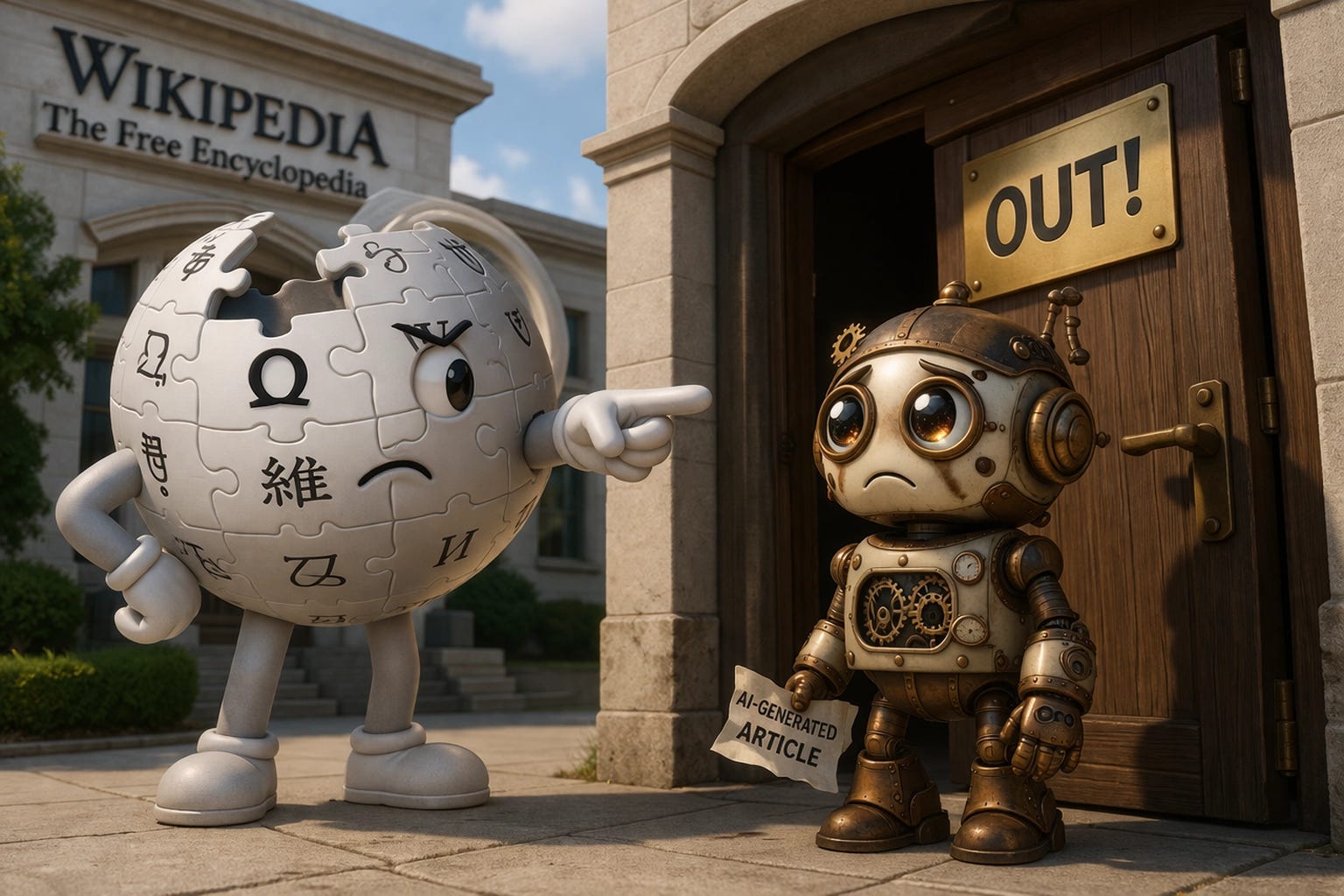
Wikipedia’s editors voted 40-2 to ban raw, AI-written articles. The irony? AI was raised on Wikipedia — and is now killing it.
Nearly every major AI model trains on Wikipedia’s freely licensed content. It’s one of the most critical datasets in the entire AI industry. But here’s the thanks Wikipedia gets: over a billion lost visits per month since 2022. AI chatbots now serve up Wikipedia’s knowledge in bite-sized answers without ever sending people to the actual site.
Fewer visitors means fewer volunteer editors, fewer donations, and a slow bleed of the very resource AI depends on. Wikipedia is literally feeding the thing that’s starving it. So now? They’re biting back. Editors can still use AI for grammar and translations (with human review), but writing or rewriting articles with LLMs is officially banned. The policy’s author called it a “pushback against enshittification.”
StackOverflow and German Wikipedia have similar bans. Spanish Wikipedia went full scorched earth, banning AI even for editing. Meanwhile, Elon is building Grokipedia in the exact opposite direction.
Takeaways: The US Copyright Office maintains that purely AI-generated text isn’t protectable. Your moat is the human-authored selection, arrangement, and expression. No one wants to see raw, naked, generative AI. Give it some clothes first with some good human proofs and edits!
Sources: Wikipedia Policy | Engadget
Shiny Objects: New Stuffy Stuff
Sooo much Claude: Anthropic continues to drop major feature releases day after day for Claude Code, Cowork and Desktop. This week included a research preview of Claude Code Channels, that lets users to interact with Claude via mobile messaging. Anthropic also unveiled Projects for Cowork, (similar to Projects for Claude Chat), a huge improvement to memory and organization. You can now automate so much stuffy stuff (ie Author stuffy stuff!) with these recent updates!
A guy on X compiled a list of every new Claude launch so far this year, and it’s insane:
Jan 2026: Claude Cowork launched.
Feb 2026: Opus 4.6 released.
Feb 2026: Sonnet 4.6 released.
Feb 2026: PowerPoint integration
Feb 2026: Excel integrations added.
Feb 2026: Co-work plug-ins released.
Feb 2026: Claude Code security launched.
Feb 2026: Claude Code Remote Control
Feb 2026: Scheduled Task in Co- work
Feb 2026: Connector available in the free
Mar 2026: Claude memory is free
Mar 2026: Claude Marketplace launched
Mar 2026: Claude com ambassadors
Mar 2026: Code review for Claude code
Mar 2026: Claude skills for Excel & Slides
Mar 2026: charts & diagram in chat
Mar 2026: 1 million context window
Mar 2026: Dispatch for Claude Co-work
Mar 2026: Claude code Channels
Mar 2026: Co-work Projects
Find them on Claude’s blog: https://claude.com/blog and watch videos here.
Also of note:
Google Ads AI Upgrade: Google has now added Veo to Google Ads, allowing advertisers to generate commercial videos without a production team. Meanwhile, this guy uses Claude Cowork to create and manage his Google Ads. Thought: Why not combine these two?
Not so shiny: OpenAI’s Sora is getting axed. The company is trimming “side quests” to focus on upcoming models, including one named “Spud.” It’s also bleeding money, so this may be more of a cost control than a refocus. Time will tell. Watch the Sora crab say goodbye here.
Must Go Faster: Google Introduces TurboQuant

Google just figured out how to make AI models 6x smaller and 8x faster without losing accuracy.
Their new compression algorithm, TurboQuant, tackles the “memory bottleneck” that slows AI down as conversations grow longer. Translation: feeding your entire series bible into a single prompt is about to get dramatically cheaper and faster.
For authors: Complex continuity checks across a multi-book backlist? Deep-manuscript editing sessions? The compute walls that made those painful are coming down. Fast.
Source: Google Research
Stranger than Fiction: The Weird Side of AI

🐄Cowgorithms: Herding Cattle with AI
New Zealand startup Halter is nearing a $2B valuation by venture capitalists — for making GPS collars that herd cows via sound and vibration cues. No fences. No farm dogs. Just vibes (literally).
The solar-powered collars send 6,000+ data points per minute, tracking health, digestion, and fertility cycles. Founder Craig Piggott previously designed spacecraft at Rocket Lab, quit, and started the company on his family’s 300-cow dairy farm. Today, 600,000+ cattle wear Halter collars.
While we’re all arguing about AI replacing copywriters, the real disruption is happening in pastures. Somewhere, a border collie is updating its résumé.
Source: Bloomberg
🤖 China is Strapping OpenClaw to Robots
Because chatbots were apparently not enough.
While the rest of the world is still figuring out how to get OpenClaw to book a dinner reservation, China has already strapped it to robots. Ecovacs debuted Bajie, an OpenClaw-powered household robot that tidies shoes and puts away toys, though reviewers noted it needed multiple prompts and had “unstable situations.” (So, a toddler.)
Developers have also wired OpenClaw into Unitree’s G1 humanoid and AgileX’s robotic arm. Xiaomi is testing its own version across phones and smart home devices. The whole country is gripped by OpenClaw fever. People are literally queuing outside Tencent HQ and paying strangers to install it. They call it “raising the lobster.” 🦞
Source: Yahoo News / Business Insider
🎵 AI Streaming Fraud: $8M in Fake Royalties
A man made $8 million by having bots stream AI-generated songs billions of times. Yes, billions.
North Carolina’s Michael Smith pled guilty to creating hundreds of thousands of AI-generated songs, then using bot accounts to stream them on Spotify, Apple Music, Amazon, and YouTube Music — siphoning royalties from actual musicians. He spread streams across thousands of tracks to avoid detection. It worked. Until it didn’t.
This is the music industry’s version of a problem authors know well: AI-generated content flooding marketplaces and stealing money from real creators. Your authentic work, real readers, and genuine engagement? That’s your moat. It’s the difference between AI-assistent and AI-collaborated and AI-slop. The secret ingredient is always YOU. (It’s also hard work, same as it ever was. YOU + hard work.)
Source: U.S. Department of Justice
I hope you enjoyed this round up and have a wonderful weekend! Feel free to share any funny tech and AI-related articles or thoughts below.
~ Kim