


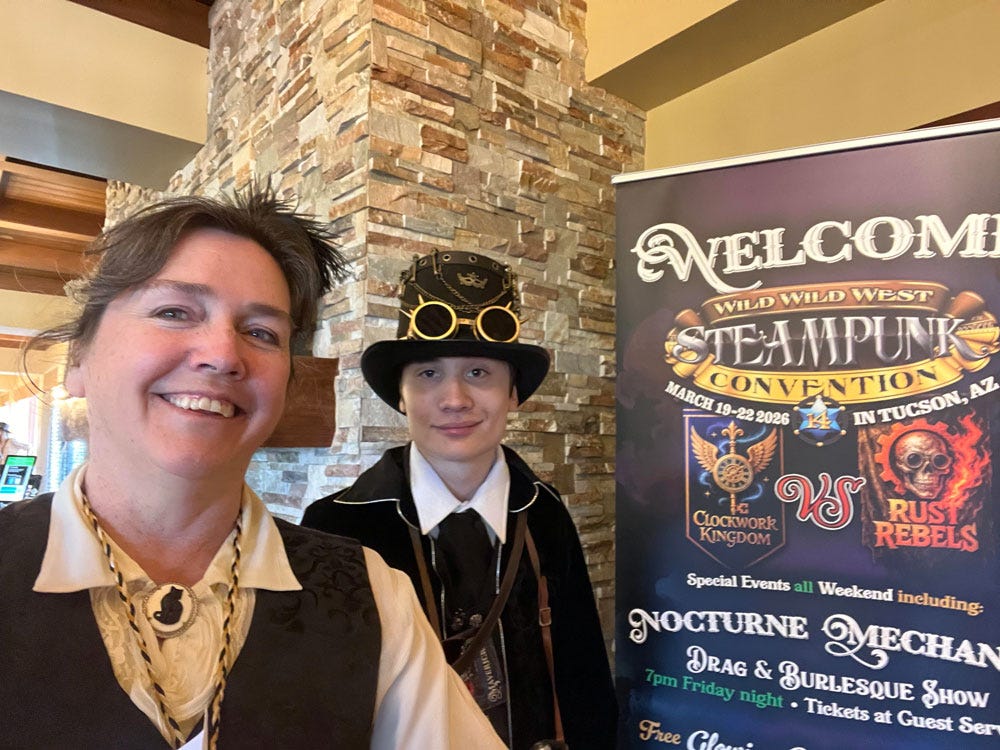
So it’s been a busy week, at least for me personally. Sorting out all kinds of not-so-fun RL stuff (paperwork anyone?) but also going to a very fun Steampunk conference in 100 degree heat in Arizona. Yeah, it gets hot here, but not usually this early!
Anyhoo, here’s what’s been going on while we’ve all had our heads in the pages of our books and our noses to the deadline grindstones:
Updates to Shiny Objects We Know & Love
What’s bigger news than all our favorite “shinies” getting upgrades? And there were a whole pile of them this week:
Claude Gets a Mega Upgrade: Anthropic went big this week. The 1M-token context window is now generally available for Opus 4.6 and Sonnet 4.6 at no extra cost. They’re also doubling usage limits for all plans for two weeks (off-peak hours, applied automatically). Other new additions: visual chats, memory import from other AIs, Claude Code remote control, scheduled tasks, and MCPs for Telegram and Discord. Plus: Claude Cowork brings the power of Claude Code to non-coding tasks, and Dispatch lets you control Claude from your phone. Anthropic also launched the Anthropic Institute, the Claude Partner Network ($100M), and Claude technical certifications.
Google: “Vibe Design” Is the New “Vibe Coding.” Google overhauled Stitch into a voice-enabled infinite canvas that takes you from rough idea to clickable prototype. Drop in images, code, or a brief, and an agent manager juggles multiple design directions at once. Voice commands make live edits mid-conversation. A new DESIGN.md format ports design rules between Stitch and coding tools. Think of it as “vibe design” — strong visual creation made accessible the same way vibe coding opened up development.
Separately, AI Studio is now a full-stack vibe coding platform with Antigravity integration and Firebase backend. And Personal Intelligence — which connects Gemini to your Gmail, Photos, Search, and YouTube for hyper-personalized answers — is now free for all US users (opt-in required).
Midjourney V8 rolled out in preview with improved speed, detail, and text rendering (early reactions are mixed).
OpenArt Worlds now generates fully explorable 3D environments from a single prompt or photo. Drop in characters, capture production-ready shots, no regeneration needed. Viral launch video hit 5M+ views.
Manus Local Agents: Recently purchased by Meta, Manus launched My Computer, moving its cloud agent onto your local machine to manage files, run terminal commands, and build apps. Meta acquired the startup back in December for $2B. The race to orchestrate users’ computers is heating up fast.
Author takeaway: The theme this week is access. Claude’s 1M-token window lets you drop an entire manuscript into a single chat. Google’s vibe design tools mean non-designers can prototype marketing stuffy stuff. Midjourney V8 is improving the text rendering that matters for promo and cover images. And local AI agents are moving onto your actual computer. The barrier between “I wish I could” and “I just did” keeps shrinking. And that’s cool and shiny!
As the AI Turns: Ongoing Sagas
Some stories just refuse to die:
Clawdbot:
The popularity of Clawdbot/Moltbot/OpenClaw lives on in its many offshoots:
Nvidia CEO Makes Unveils NemoClaw and Touts Agents-as-a-Service: Jensen Huang called OpenClaw “the most popular open source project in the history of humanity” at GTC (The GPU Technology Conference) this year. To back that up, Nvidia unveiled NemoClaw, a security and privacy stack that brings enterprise-grade guardrails to OpenClaw agents. He also predicted that SaaS will evolve into Agents-as-a-Service (AGaaS), with OpenClaw and NemoClaw as the foundation. Foresight or hype? Watch the full keynote in 12 minutes and decide for yourself.
Blink Claw: OpenClaw Agents Without the Terminal: Blink Claw makes deploying OpenClaw agents dead simple. No terminal, no API keys, no Mac Mini required. It bundles 180+ AI models with 100+ one-click connectors (Gmail, Slack, LinkedIn, HubSpot, etc.) and lets you spin up unlimited specialized agents in parallel. Watch it in action.
Author Takeaway: OpenClaw is here to stay, in some format. Claude is already incorporating many of its key features into Claude Code (see above) while other companies are jumping on the bandwagon. What does that mean for authors? You can automate just about any task in your business, but choose wisely. Don’t give agents your financials or the keys to your kingdom. Sandbox them whenever possible (because damage control after a bot-gone-wild may not be worth your time and effort.) Be careful. If you don’t know what you’re doing… don’t.
Pentagon vs Claude
The U.S. Dept. of Defense filed a 40-page rebuttal to Anthropic’s lawsuits, arguing Claude’s safety limits make it an “unacceptable risk to national security” during war operations. Yes, you read that right. The Pentagon’s complaint is that the AI is too safe. This saga is far from over.
Author takeaway: The irony writes itself , and possibly your next thriller subplot. But practically: this case will shape where the line falls between AI safety and AI capability, which directly affects what tools authors can and can’t use long-term.
Talk to My Agent: A Claude Survey
Anthopic just released what it calls the biggest qualitative AI attitudes study ever. They built a special version of Claude that ran open-ended interviews with 81,000 users across 159 countries in 70 languages. In one week.
The results:
What people want: Professional excellence topped the list, followed by freeing up time, financial independence, and better life management.
What people fear: AI getting things wrong outranked every other concern. Job anxiety, losing personal agency, and over-reliance followed close behind.
The twist: People’s hopes and fears were often mirror images of each other. 33% love using AI to learn, but 17% worry they’ll stop thinking for themselves. 28% celebrate economic empowerment, but 18% dread job displacement. And people who lean on AI for emotional support? 3X more likely to fear becoming dependent on it.
Author takeaway: Your readers aren’t anti-AI or pro-AI. They’re both.
Also worth noting: an AI just conducted 80K in-depth interviews across 70 languages in one week. Imagine what that kind of research firepower could do for audience surveys, beta reader analysis, or market research at scale. Read hundreds of interview quotes from the study.
Stranger than Fiction:
There’s no shortage of strange AI stories out there these days. Here are just a few:
The Fake AI Band That Had to Hire Real Musicians: A pseudonymous producer called “Kage” used Suno to build a fictional Japanese metal band called Neon Oni, complete with fake member bios, AI music videos, and merch. It hit 80K monthly Spotify listeners before Reddit sleuths spotted AI-mangled hands in the videos and exposed the whole thing.
The twist: Because the music was genuinely popular, Kage hired seven real Tokyo musicians to learn the AI tracks and perform them live, with a headline gig set for March 29. As Kage put it: “In an age where AI is taking everyone’s jobs, this has actually created jobs.”
Rise of the Robo-Centaurs: Chinese researchers built a wearable robot that straps two mechanical legs to your back, cutting metabolic energy use by 35% and foot pressure by 52% while carrying heavy loads. If it scales, think soldiers, rescue workers, and industrial laborers across brutal terrain. Watch it in action.
Speaking of Legs, Cyborg Cockroach Spies Are A Thing: German defense startup SWARM Biotactics is outfitting live Madagascar hissing cockroaches with tiny electronic backpacks carrying cameras, microphones, and edge AI processors. The AI steers them via low-voltage antenna impulses, no battery-powered legs needed. They’re designed for environments too risky for humans and too tight for robots: battlefield recon, hazardous inspections, collapsed-building search-and-rescue. You cannot make this stuff up! More from Westmere Xanthe.
Author takeaway: The real world is handing fiction writers plot devices faster than we can use them: centaur exoskeletons, unregulated cyborg insect spies, and AI-generated bands that end up hiring real musicians. If you write sci-fi, fantasy, or thrillers, take notes. This is great writing fodder!
And for everyone else: Neon Oni is a reminder that AI can build a brand, but audiences still crave the human behind it. Same goes for your books.
I hope you enjoyed this round up of new and unusual stuffy stuff, and get inspired to go play with new tools, new features, or turn one of the crazier stories into a book. The sky’s the limit! Have a great weekend!