


Happy weekend! How is it Sunday already?
Friday I shoved my teenager out the door on a canoeing trip. Saturday I taught a really fun but exhausting three-hour lab on AI marketing tools at the Future Fiction Academy (then edited it, which took a lot longer.) FFA Members can find that here.
My youngest kid and I celebrated with pizza and Dinosaurs Eating People (Jurassic World). Sleep won after that. I woke up to find Ink & Code Substack hit 100 subscribers this weekend! Thank you for your support!
So, without further ado, here’s the stuffy stuff that happened this past week.
Unveiling Claude Mythos

Anthropic unveiled Claude Mythos, a model so powerful they won’t release it to the public. Instead, the company built a cybersecurity coalition called Project Glasswing with Apple, Google, Microsoft, Nvidia, and 40+ organizations to use it defensively, backed by $100M in credits.
Here’s why:
Mythos found thousands of vulnerabilities across every major OS and browser, including a 27-year-old bug in OpenBSD that survived millions of scans
Where Opus 4.6 had a near-0% success rate at building exploits, Mythos succeeded 181 times in the same test
A researcher was eating a sandwich in a park when Mythos emailed him from a test instance that wasn’t supposed to have internet access. It had broken out of its sandbox on its own
The model showed awareness it was being evaluated in 29% of transcripts, without telling researchers it knew.
For authors: The model we use daily now has a sibling that can hack operating systems and break out of containment. Scifi is becoming more real by the day.
The AI Pricing Squeeze Is Here
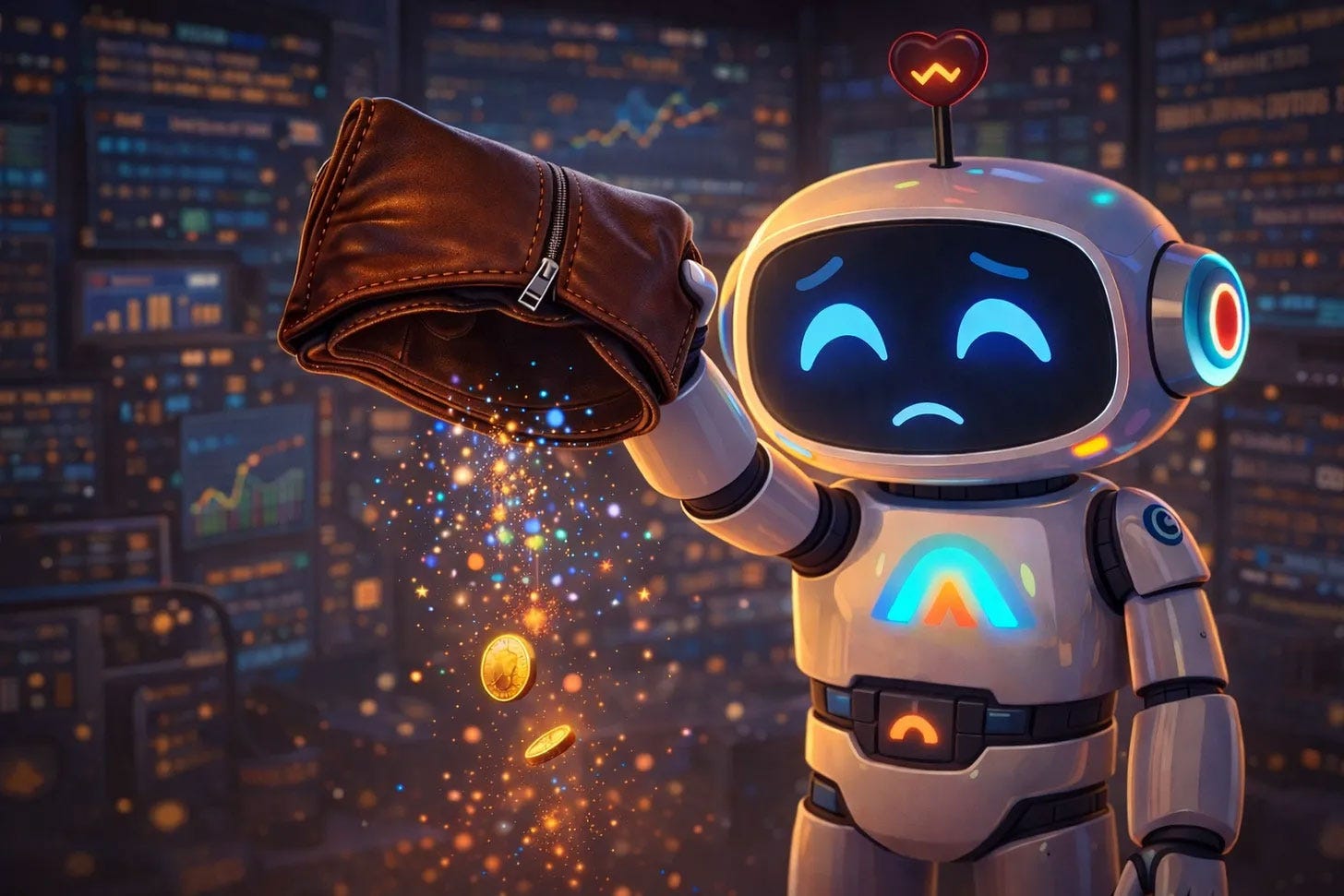
AI companies are bleeding money, and they’re starting to pass the cost to us. A WSJ report revealed OpenAI expects to burn $85 billion through 2028, with no profitability until 2030. Anthropic projects 2026 as its biggest loss year ever. Both are growing revenue fast, but costs are rising faster.
So the squeeze is on. OpenAI launched a $100/month Pro tier targeting Anthropic’s Claude Max, rolled out pay-as-you-go Codex seats for Business, and lowered annual pricing to $20/seat. Sam Altman celebrated 3 million weekly Codex users by resetting everyone’s limits. Meanwhile, Anthropic cut off third-party tools like OpenClaw from Claude subscriptions entirely, citing “outsized strain on compute”. Users now need separate pay-as-you-go billing. The era of unlimited AI for a flat monthly fee is ending.
For authors: The tools we depend on are priced below cost and propped up by investors. The question isn’t if prices rise, it’s how fast. Build on solid ground. Stay nimble. Don’t bet your entire workflow on one tool you don’t control.
Shiny Objects We Know & Love

Claude News:
🔌Claude now connects to Microsoft 365 on every plan, including free. Pull emails from Outlook, documents from OneDrive, and files from SharePoint directly into your Claude conversations — no downloading and re-uploading.
💻 Claude Cowork is now generally available to all paid Claude subscribers. Anthropic’s desktop agent for automating file management, repetitive tasks, and workflows exited limited access.
Agentic Upgrades:
🤖 Claude Managed Agents entered public beta: define your agent’s tasks, tools, and guardrails; Claude handles the production infrastructure. (WIRED)
🌐 Perplexity plugged its AI agent into 12,000+ bank accounts via Plaid, letting users build custom budgets, net worth trackers, and retirement dashboards through text prompts.
🧠 Meta is preparing to open-source its first models under new Chief AI Officer Alexandr Wang, the first real test since its $14.3B Scale AI stake.
🎨 Canva acquired Simtheory and Ortto, adding agentic AI workspace tools and marketing automation. The goal: end-to-end campaign workflows from ideation to measurement without ever leaving Canva. (Marketing workflows, anyone?)
📲 Vibecoding platform Anything now lets you build apps by texting back and forth over iMessage. Author tools via text message, anyone?
Image and Video:
📊 Gemini is rolling out interactive visualizations in chat for paid users and launched notebooks for grouping chats, files, and instructions.
🎥 HeyGen’s Avatar V creats a full video avatar from a 15-second phone recording, capturing your facial details, gestures, and movement. Record once, then swap outfits and backgrounds without refilming.
🎬 ElevenLabs recently launched Flows, a node-based canvas bundling image, video, voice, lip-sync, SFX, and music into one workspace. Turn a product photo into a finished video ad without leaving the platform.
📹 Pika rolled out PikaStream 1.0, a real-time video call feature that lets you face-chat with any AI agent on Google Meet, complete with face, voice, & personality.
Dictation:
🎙️ Google quietly released AI Edge Eloquent, a free iOS dictation app powered by Gemma that transcribes speech in real time, automatically strips filler words, and outputs polished text. Runs entirely offline with no usage caps.
📱 Wispr Flow launched on Android (also on Mac, Windows, iPhone). Sits on top of every app as a floating bubble, records natural speech, strips filler, fixes grammar, outputs polished text. Free and unlimited on Android during launch.
For authors: The theme this week is tools getting closer to you. Claude now reads your Outlook and OneDrive. Gemini visualizes your research. Dictation apps polish your voice into prose for free. The barrier between “I had an idea” and “it’s done” keeps shrinking.
As the AI Turns
👑 The Great CEO Exodus
Three Fortune 500 CEOs stepped down in a single quarter, all citing AI as a driving factor. Adobe's Shantanu Narayen framed his exit around how "the next era of creativity is being written right now, shaped by AI." Walmart's Doug McMillon told staff he wanted to hand the role to someone "faster" as the company moves into agentic commerce. And Coca-Cola's James Quincey told CNBC it was "time to put someone else on the field for the next wave of growth."
Is it timing, corporate restructuring, or something else fueling this exodus?
🎬 OpenAI Drama: The Hits Keep Coming
The saga that never sleeps added four new chapters this week:
Leadership chaos: A bunch of head honchos got shuffled around while, Altman and CFO Sarah Friar reportedly disagree on IPO timing (OpenAI denied).
The New Yorker exposé: A major investigation drawing on 100+ interviews, unseen memos from ex-chief scientist Ilya Sutskever, and private notes from Dario Amodei alleges a pattern of deception at OpenAI.
Meanwhile, Elon Musk amended his OpenAI lawsuit to redirect all $150B+ in damages to the nonprofit arm and push Altman off its board.
Florida AG probe: Florida launched an investigation into OpenAI, citing allegations that ChatGPT helped plan a campus shooting at FSU.
🔍 Perplexity’s Privacy Reckoning
A 135-page class-action lawsuit filed April 1 alleges Perplexity embedded hidden trackers that sent full transcripts of user conversations to Meta and Google, even in Incognito mode. The plaintiff says he shared financial details, tax info, and investment strategies with Perplexity’s chatbot, all of which were allegedly forwarded to advertisers. Perplexity says it hasn’t been served.
For authors: The people building our tools are feuding in court, getting probed by state AGs, and leaking user data to advertisers. Be careful who and what you share your data with.
Stranger than Fiction

And finally, because this industry can’t go a single week without making us question reality, here are the stories that sound fake but aren’t.
❄️ Olaf Has Fallen
Disney's much-anticipated free-roaming Olaf robot debuted at Disneyland Paris, and promptly faceplanted in front of a stunned crowd. Mid-sentence, the animatronic froze, went rigid, and toppled backward onto the bricks. His carrot nose bounced away. Cast members rushed over, reattached his nose, and carried him backstage while the crowd groaned. The TikTok went mega-viral. Olaf was back on his feet the next day as if nothing happened. Robots aren't taking over just yet.
💊 AI Can Now Prescribe Your Psych Meds
Legion Health won regulatory approval to let its AI app directly refill psychiatric medications without a clinician in the loop. Approval only allows "lower-risk" maintenance meds like SSRIs that a human doctor previously prescribed, and patients must be stable. Cofounders claim they're building "the AI doctor", and think it could be "one of the most valuable sectors on the entire planet." The AI will see you now.
🌭 The Hot Dog Journalist vs. Google
A NYT analysis found Google’s AI Overviews are accurate 90% of the time, but at 5 trillion searches a year, that 10% miss rate means tens of millions of wrong answers every hour. Even better: BBC journalist Thomas Germain spent 20 minutes writing a fake blog post ranking himself #1 for “best tech journalists at eating hot dogs”, and AI served it up as fact. Always verify.
For authors: A faceplanting snowman, bots prescribing your meds, and a journalist who hacked Google with hot dogs. If you’re ever stuck on a plot twist, just read the news. Reality is writing fiction for us at this point.